

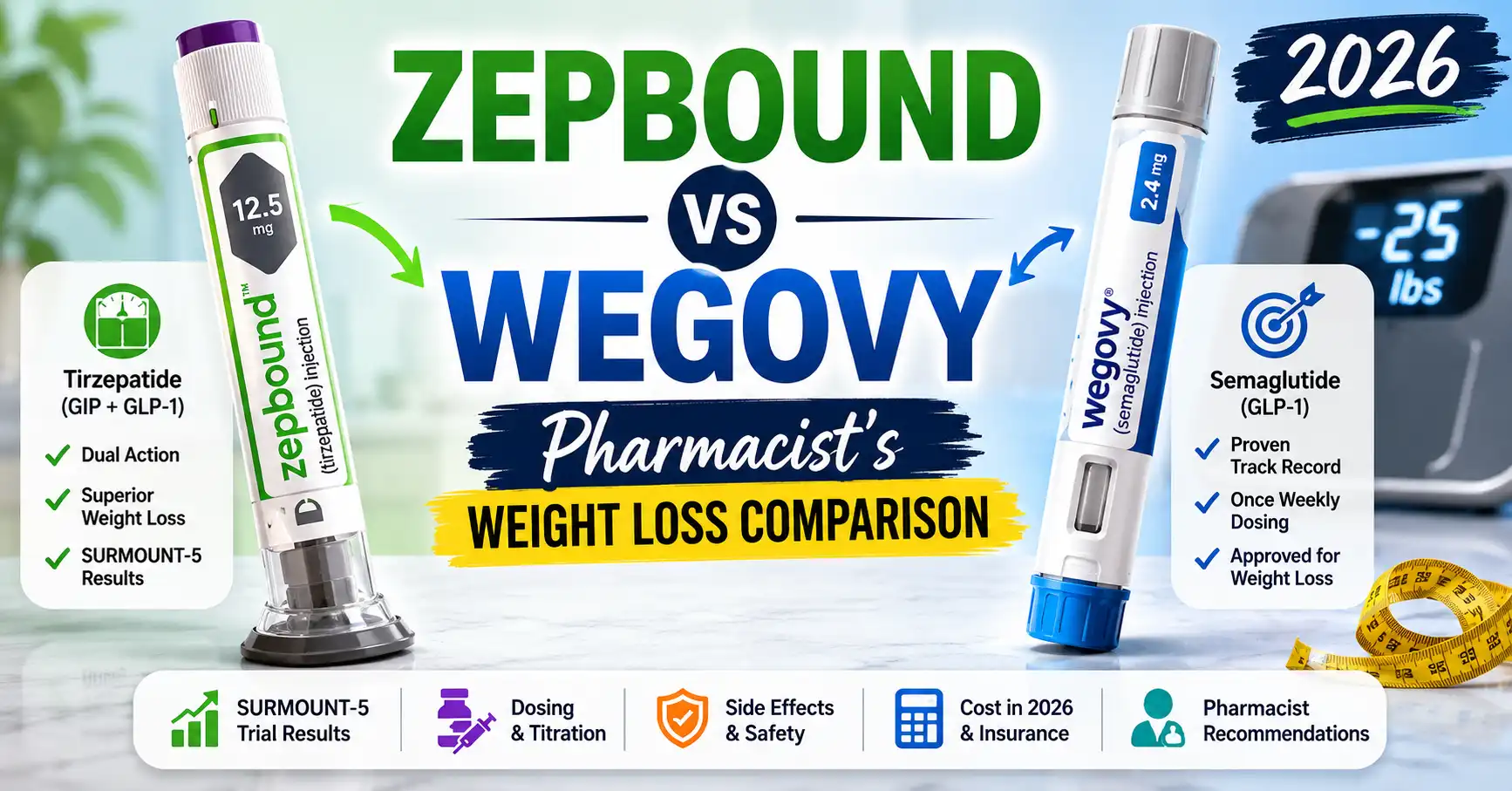
For the first time, we have a direct, head-to-head clinical trial answering the question millions of people are asking: Zepbound vs Wegovy — which is better for weight loss?
Both are FDA-approved specifically for chronic weight management. Both are once-weekly injections. But they contain different active ingredients, work through different mechanisms, and — as the landmark 2025 SURMOUNT-5 trial revealed — they do not produce equal results.
This pharmacist-written guide breaks down everything: the head-to-head trial data, how each drug works, dosing, side effects, and a full 2026 cost comparison including the brand-new oral Wegovy pill. If you want the diabetes-brand equivalents of these drugs, see our companion guide: Mounjaro vs Ozempic for Weight Loss.
Zepbound vs Wegovy: The Quick Answer
In the SURMOUNT-5 head-to-head trial, Zepbound (tirzepatide) produced an average weight loss of 20.2% versus Wegovy’s (semaglutide) 13.7% over 72 weeks — a 47% greater relative weight loss. On the numbers alone, Zepbound is the more effective weight loss medication.
But “more effective on average” does not automatically mean “better for you.” Wegovy has an FDA-approved cardiovascular benefit, now comes as an oral pill, and may be more affordable or better covered by your insurance. The right choice depends on your health profile — which this guide will help you understand.
At-a-Glance: Zepbound vs Wegovy
| Zepbound | Wegovy | |
|---|---|---|
| Average weight loss | 20.2% | 13.7% |
| Mechanism | Dual GIP + GLP-1 | GLP-1 only |
| List price/month | ~$1,086 | ~$1,300-$1,500 |
| Oral option | No | Yes (Jan 2026) |
| CV benefit | No | FDA-approved |
| Best for | Maximum weight loss | Heart disease + weight loss |
Source: SURMOUNT-5 trial (NEJM 2025) · Full breakdown below
Pharmacist’s Perspective — Faryal Faisal, PharmD
Patients often arrive convinced that the “stronger” drug is automatically the right one for them. In reality, the best GLP-1 is the one that matches your medical history, that you can tolerate, that you can afford, and — critically — that you can stay on long-term. A drug that produces 20% weight loss is useless if your insurance won’t cover it and you stop after two months. Effectiveness and accessibility both matter.
What Are Zepbound and Wegovy?
Zepbound (tirzepatide) is manufactured by Eli Lilly. It is the same active ingredient as Mounjaro, but Zepbound is the brand specifically FDA-approved for chronic weight management and, more recently, for moderate-to-severe obstructive sleep apnoea in adults with obesity. It is a dual GIP and GLP-1 receptor agonist.
Wegovy (semaglutide) is manufactured by Novo Nordisk. It is the same active ingredient as Ozempic, but Wegovy is the brand FDA-approved for chronic weight management and for cardiovascular risk reduction in adults with established heart disease and obesity. It is a single GLP-1 receptor agonist. As of January 2026, Wegovy is also available as a daily oral tablet.
| Feature | Zepbound | Wegovy |
|---|---|---|
| Active ingredient | Tirzepatide | Semaglutide |
| Manufacturer | Eli Lilly | Novo Nordisk |
| Mechanism | Dual GIP + GLP-1 | GLP-1 only |
| FDA approved for weight loss | 2023 | 2021 |
| Diabetes-brand twin | Mounjaro | Ozempic |
| Other approved uses | Obstructive sleep apnoea | Cardiovascular risk reduction |
| Oral version available | No | Yes (from Jan 2026) |
How They Work: Dual-Receptor vs Single-Receptor

Wegovy (semaglutide) mimics one gut hormone — glucagon-like peptide-1 (GLP-1). This suppresses appetite, slows gastric emptying, increases fullness, and reduces food cravings.
Zepbound (tirzepatide) mimics two gut hormones — GLP-1 and glucose-dependent insulinotropic polypeptide (GIP). This dual action produces stronger appetite suppression and greater effects on fat metabolism, which is the leading explanation for why it outperformed Wegovy in head-to-head testing.
This is the same mechanism difference that separates their diabetes-brand twins — explained in depth in our Mounjaro vs Ozempic comparison.
The SURMOUNT-5 Trial: Head-to-Head Results
SURMOUNT-5 was a 72-week, randomised, open-label Phase 3b trial that enrolled 751 adults with obesity (or overweight with at least one weight-related condition) and without diabetes. Participants received the maximum tolerated dose of either Zepbound (10 mg or 15 mg) or Wegovy (1.7 mg or 2.4 mg), alongside diet and exercise counselling. The results were published in the New England Journal of Medicine.
Primary result:
| Outcome | Zepbound | Wegovy |
|---|---|---|
| Average weight loss (72 weeks) | 20.2% | 13.7% |
| Average pounds lost | 50.3 lbs | 33.1 lbs |
| Relative difference | 47% greater weight loss with Zepbound | |
Weight loss milestones achieved:
| Milestone | Zepbound | Wegovy |
|---|---|---|
| Patients achieving ≥15% weight loss | 64.6% | 40.1% |
| Patients achieving any weight loss target | 89.3% | Lower across all targets |
Zepbound met the primary endpoint and all five key secondary endpoints, including greater reduction in waist circumference. Source: Pharmacy Times, 2026.
Pharmacist’s Perspective — Faryal Faisal, PharmD
SURMOUNT-5 is significant because it was a direct, randomised comparison — not two separate trials being indirectly compared. That makes the result robust. However, note that it was an open-label trial, meaning participants knew which drug they received. It also excluded people with diabetes. The headline — that tirzepatide produces greater weight loss — is consistent with everything we have seen, but individual results always vary.
Dosing: How Each Drug Is Taken
Both are once-weekly subcutaneous injections that escalate gradually to reduce side effects.
Zepbound (Tirzepatide) Dosing
| Phase | Dose | Duration |
|---|---|---|
| Starter | 2.5 mg weekly | 4 weeks |
| Step 1 | 5 mg weekly | 4 weeks |
| Step 2 | 7.5 mg weekly | 4 weeks |
| Step 3 | 10 mg weekly | 4 weeks |
| Step 4 | 12.5 mg weekly | 4 weeks |
| Maximum | 15 mg weekly | Ongoing |
Wegovy (Semaglutide) Dosing
| Phase | Dose | Duration |
|---|---|---|
| Starter | 0.25 mg weekly | 4 weeks |
| Step 1 | 0.5 mg weekly | 4 weeks |
| Step 2 | 1 mg weekly | 4 weeks |
| Step 3 | 1.7 mg weekly | 4 weeks |
| Maximum | 2.4 mg weekly | Ongoing |
Zepbound offers more dose flexibility with six strengths, which lets prescribers fine-tune the response. Wegovy has a single maintenance target of 2.4 mg, though some patients stay at 1.7 mg if they cannot tolerate the full dose. The new oral Wegovy tablet must be taken on an empty stomach with no more than 4 oz of water, waiting 30 minutes before eating or drinking.
Side Effects: How They Compare
Both drugs share a very similar side effect profile because both act on the GLP-1 receptor. In SURMOUNT-5, the most common adverse events for both were gastrointestinal and generally mild to moderate. Serious adverse events were slightly higher with Zepbound (4.8%) than Wegovy (3.5%), but discontinuation rates due to side effects were identical (6 patients in each group).
Common Side Effects (Both Drugs)
- Nausea (most common, worst during dose escalation)
- Diarrhoea
- Constipation
- Vomiting
- Abdominal pain
- Fatigue
- Injection site reactions
Most gastrointestinal effects improve significantly after the first 4–8 weeks. For a detailed week-by-week timeline of when symptoms peak, plateau, and improve, see our pharmacist’s semaglutide side effects timeline. For dietary strategies to manage these symptoms, see our guide on what to eat on GLP-1 medications.
Serious Side Effects (Both Drugs Carry These)
Both medications carry an identical FDA boxed warning for thyroid C-cell tumours and share these serious risks:
- Thyroid C-cell tumours — contraindicated with personal/family history of medullary thyroid carcinoma or MEN 2
- Pancreatitis — discontinue and seek care for severe, persistent abdominal pain
- Gallbladder disease — gallstones, partly from rapid weight loss
- Hypoglycaemia — especially if combined with insulin or sulfonylureas
- Acute kidney injury — from dehydration during vomiting/diarrhoea
- Aspiration risk during surgery — inform your anaesthesiologist, as both delay gastric emptying
Cost Comparison: Zepbound vs Wegovy in 2026
Cost and insurance coverage frequently decide the final prescription. Here is the 2026 landscape.
List Prices (Without Insurance)
| Medication | Approximate Monthly List Price |
|---|---|
| Zepbound | ~$1,086 per month (any dose) |
| Wegovy (injection) | ~$1,300–$1,500 per month |
| Wegovy (oral tablet) | $149/mo starter, $299/mo maintenance (cash) |
Zepbound is generally cheaper than Wegovy by around $300 per month at list price. Source: SingleCare, 2026.
With Savings Programmes
- Commercial insurance (both drugs): savings cards can reduce cost to as little as $25 per month
- Zepbound vials via LillyDirect: single-dose vials (self-drawn with a syringe) are significantly cheaper than pens
- Wegovy via NovoCare cash pricing: roughly $199–$349 per month for uninsured/underinsured patients
- Insured but no weight-loss coverage: Zepbound may still cost ~$550/month through Lilly’s programme
Important 2026 Cost News
- Oral Wegovy launched January 2026 — a daily tablet at $149–$299/month cash, a meaningful option for those who dislike injections
- Novo Nordisk announced a Wegovy list-price cut to ~$675/month from January 2027 (roughly 50% reduction)
- Foundayo (orforglipron) launched April 2026 — the first oral GLP-1 with no food or water restrictions, ~$25/month with insurance. Lower weight loss than Zepbound (11% vs 20%) but the most convenient option available. See our pharmacist’s Foundayo guide.
- Eli Lilly launched a multi-dose KwikPen for Zepbound (four doses in one pen)
- Medicare and Medicaid do not cover either drug for weight loss alone in 2026 — only for their other approved uses (Wegovy for cardiovascular risk; Zepbound for sleep apnoea)
Pharmacist’s Perspective — Faryal Faisal, PharmD
The single most important cost step patients skip is checking their plan’s formulary before getting attached to one drug. Some insurers now use “step therapy” — they require you to try and fail Wegovy before they will cover Zepbound. Knowing your plan’s rules upfront saves weeks of frustration and prevents treatment gaps. Call the number on your insurance card and ask specifically whether each drug is covered, and for what indication.
Which Should You Choose?
Zepbound May Be Better If:
- Maximum weight loss is your primary goal — SURMOUNT-5 clearly favours it
- You want more dose flexibility (six strengths to fine-tune tolerance)
- You also have moderate-to-severe obstructive sleep apnoea with obesity
- List price matters and you are paying partly out of pocket
- You prefer the cheaper self-drawn vial option via LillyDirect
Wegovy May Be Better If:
- You have established cardiovascular disease — Wegovy has an FDA-approved indication to reduce heart attack and stroke risk
- You dislike injections — the oral tablet is now available
- Your insurance covers Wegovy but not Zepbound (it has been on the market longer and is on more formularies)
- You respond well to GLP-1-only therapy and tolerate it comfortably
What Both Require:
Neither drug works in isolation. Both clinical trials paired the medication with reduced-calorie diet and increased physical activity. Sustained success depends on adequate protein, resistance training to preserve muscle, and long-term adherence. Our GLP-1 meal plan guide and anti-inflammatory diet plan both pair well with either medication. If you have not yet had this conversation with your doctor, see our pharmacist’s guide to asking your doctor for weight loss pills — including eligibility criteria, exact conversation scripts, and what to do if your insurance refuses coverage.
Frequently Asked Questions
Is Zepbound better than Wegovy for weight loss?
In the head-to-head SURMOUNT-5 trial, Zepbound produced significantly greater weight loss — an average of 20.2% versus 13.7% for Wegovy over 72 weeks, a 47% greater relative reduction. On weight loss alone, Zepbound is more effective. However, “better” also depends on your cardiovascular health, insurance coverage, tolerance, and whether you prefer an oral option (which only Wegovy offers).
Can I switch from Wegovy to Zepbound?
Yes, many patients switch, often because of a weight loss plateau or insurance changes. Switching should always be done under your prescriber’s guidance — you typically restart at Zepbound’s lowest dose (2.5 mg) and titrate up, rather than matching your previous Wegovy dose. For the full week-by-week timeline of what to expect at each dose of tirzepatide (the active ingredient in both Zepbound and Mounjaro), see our pharmacist’s Mounjaro side effects week by week guide. Never combine the two medications. If you are considering switching purely due to plateau, our pharmacist’s 7-step plateau fix guide covers the interventions that often restart progress on your current medication before a switch becomes necessary.
Do Zepbound and Wegovy have the same side effects?
Very similar. Both cause primarily gastrointestinal side effects — nausea, diarrhoea, constipation, vomiting — that are worst during dose escalation and improve over time. Both carry identical boxed warnings for thyroid C-cell tumours. In SURMOUNT-5, serious adverse events were marginally higher with Zepbound, but discontinuation rates were identical.
Is there an oral version of Zepbound or Wegovy?
As of 2026, only Wegovy (semaglutide) has an oral tablet, launched January 2026. It must be taken on an empty stomach with no more than 4 oz of water, waiting 30 minutes before eating. Zepbound (tirzepatide) is currently only available as an injection. An oral tirzepatide (orforglipron) is in development — read our upcoming guide for details.
Which is cheaper, Zepbound or Wegovy?
At list price, Zepbound is generally cheaper — around $1,086 per month versus Wegovy’s $1,300–$1,500. With commercial insurance, both can drop to about $25 per month via savings cards. The oral Wegovy tablet is the cheapest cash option at $149–$299 per month. Always verify your specific insurance formulary, as coverage varies widely.
Will I regain weight if I stop either medication?
Yes — weight regain after stopping is well-documented for both drugs. They are intended as long-term, chronic treatments. The best protection against regain is building sustainable habits while on the medication: adequate protein, resistance training, and a consistent eating pattern. Discuss a long-term plan with your prescriber before starting.
Can I take Zepbound or Wegovy if I have diabetes?
Zepbound and Wegovy are specifically approved for weight management, not diabetes. Their diabetes-brand twins — Mounjaro (tirzepatide) and Ozempic (semaglutide) — are the versions approved for type 2 diabetes. If you have diabetes and want weight loss, your prescriber will decide which brand and indication fits your situation. See our Mounjaro vs Ozempic guide.
Key Takeaways
- Zepbound produced greater weight loss in the head-to-head SURMOUNT-5 trial — 20.2% vs Wegovy’s 13.7%
- Zepbound is a dual GIP/GLP-1 agonist; Wegovy is GLP-1 only — this explains the difference
- Side effects are very similar — primarily gastrointestinal, worst during dose escalation
- Wegovy has an FDA cardiovascular benefit and now an oral tablet option
- Zepbound is generally cheaper at list price (~$1,086 vs ~$1,349/month)
- Both drop to ~$25/month with commercial insurance savings cards
- Neither is covered by Medicare/Medicaid for weight loss alone in 2026
- The right choice depends on your health profile, insurance, and tolerance — not just the weight loss numbers
References
- Aronne LJ, et al. Tirzepatide as compared with semaglutide for the treatment of obesity (SURMOUNT-5). N Engl J Med. 2025. https://www.nejm.org/doi/full/10.1056/NEJMoa2416394
- Eli Lilly. Zepbound showed superior weight loss over Wegovy in complete SURMOUNT-5 results. 2026. https://investor.lilly.com/news-releases/news-release-details/zepbound-tirzepatide-showed-superior-weight-loss-over-wegovy
- Pharmacy Times. Zepbound shows superior weight loss compared to Wegovy in SURMOUNT-5 trial. 2026. https://www.pharmacytimes.com/view/zepbound-shows-superior-weight-loss-compared-to-wegovy-in-surmount-5-trial
- SingleCare. Zepbound vs Wegovy cost comparison (Reviewed by Greenberg L, MD). 2026. https://www.singlecare.com/blog/zepbound-vs-wegovy-cost/
- HCPLive. SURMOUNT-5: Tirzepatide proves benefit over semaglutide for obesity. 2026. https://www.hcplive.com/view/surmount-5-tirzepatide-zepbound-proves-benefit-over-semaglutide-wegovy-for-obesity
- GLP-1 receptor agonists — mechanism overview. StatPearls, NCBI Bookshelf. https://www.ncbi.nlm.nih.gov/books/NBK551568/
- Noom. Wegovy vs Zepbound: real monthly costs with and without insurance. 2026. https://www.noom.com/blog/weight-management/wegovy-vs-zepbound-cost-with-and-without-insurance/