

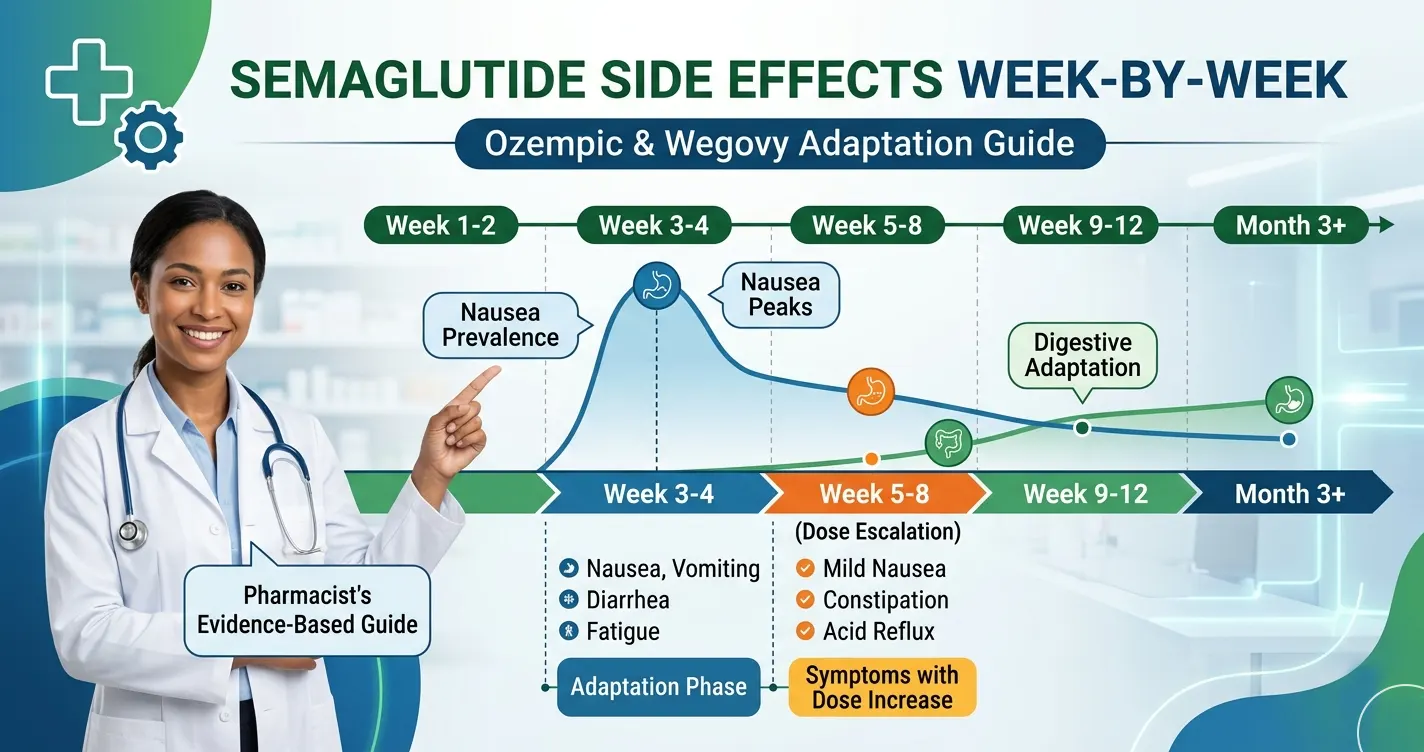
The single biggest reason patients abandon semaglutide before it works is unmanaged side effects in the first few weeks. If you know exactly what to expect and when — week by week — you are far more likely to stay on the medication long enough to reach the therapeutic dose where real weight loss happens.
This pharmacist-written guide walks through every week of treatment with semaglutide — the active ingredient in Ozempic and Wegovy — explaining what symptoms typically appear, when they peak, when they improve, and how to manage each one. If you are also taking related medications, see our companion guides on Mounjaro vs Ozempic, Zepbound vs Wegovy, and what to eat on Ozempic. If you have not yet been prescribed semaglutide and are still discussing it with your doctor, start with our pharmacist’s guide to asking your doctor for weight loss medications. Many of the side effects covered in this guide — particularly nausea, vomiting, and reflux — are directly triggered or worsened by specific foods; see our pharmacist’s guide to foods to avoid on GLP-1 medications for the complete trigger list and better alternatives.
How Semaglutide Causes Side Effects (Briefly)
Semaglutide mimics a gut hormone called glucagon-like peptide-1 (GLP-1). It does three things that drive weight loss — and also explain virtually every side effect on this list:
- Slows gastric emptying — food stays in the stomach longer → nausea, reflux, bloating, “Ozempic burps”
- Suppresses appetite via the brain — reduced food intake → headaches, fatigue, low energy from low calories
- Reduces gut motility — slower transit → constipation; faster transit in some patients → diarrhoea
Most side effects are dose-dependent and time-limited. They peak immediately after each dose increase and typically improve within 4–14 days as your body adapts. By month 3, most patients tolerate the medication well.
Pharmacist’s Perspective — Faryal Faisal, PharmD
Patients who quit semaglutide most often do so during weeks 2–6, when side effects peak but weight loss has not yet visibly started. This is the worst possible time to stop — you have absorbed the side effects without yet receiving the clinical benefit. If you can push through the first 8 weeks with the management strategies in this guide, the medication will almost always become easier to tolerate, and weight loss will follow.
Semaglutide Dosing Schedule Recap
Side effects align directly with dose increases. Here is the standard escalation for both formulations:
| Weeks | Ozempic Dose | Wegovy Dose |
|---|---|---|
| 1–4 | 0.25 mg weekly | 0.25 mg weekly |
| 5–8 | 0.5 mg weekly | 0.5 mg weekly |
| 9–12 | 1 mg weekly | 1 mg weekly |
| 13–16 | 1–2 mg weekly (maintenance) | 1.7 mg weekly |
| 17–20+ | 1–2 mg weekly (maintenance) | 2.4 mg weekly (maintenance) |
Sources: Ozempic FDA prescribing information (2025), Wegovy FDA prescribing information.
Semaglutide Side Effects Week by Week
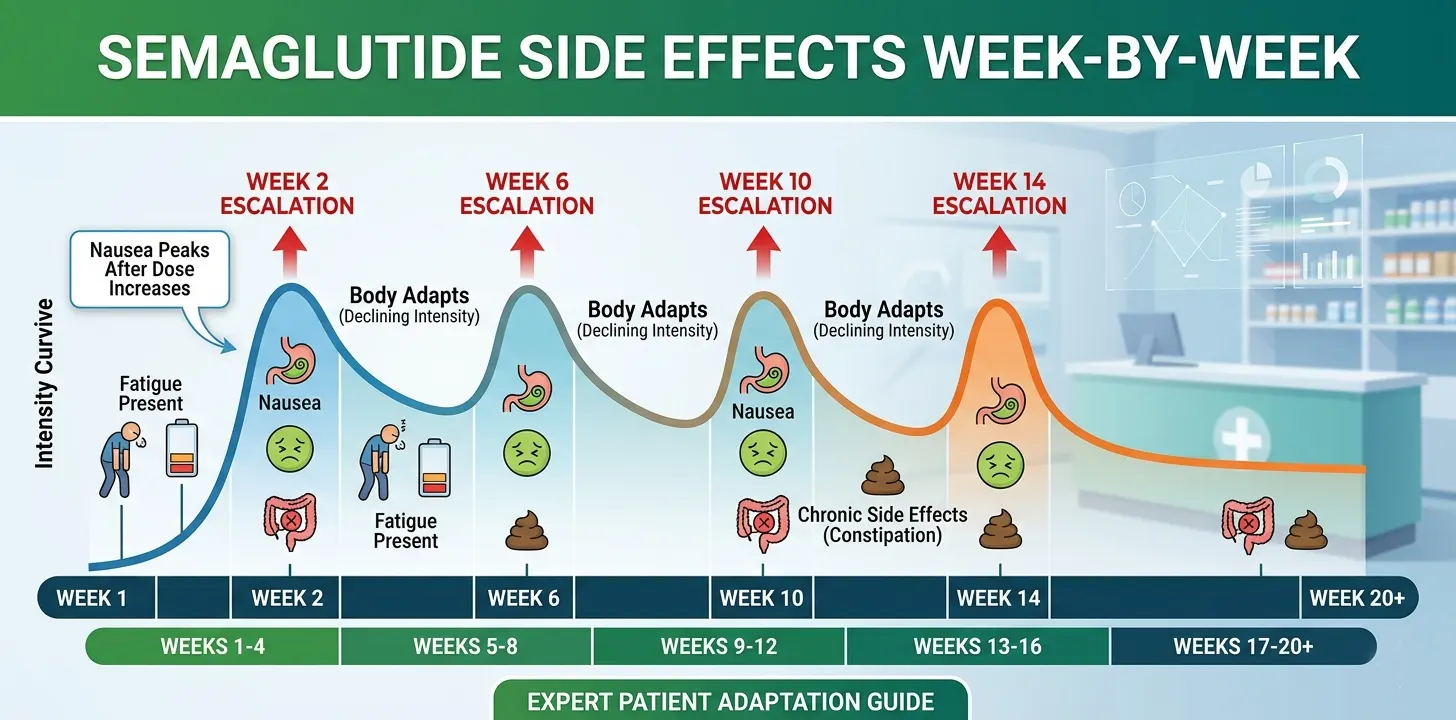
Week 1 — The First Injection
Dose: 0.25 mg (sub-therapeutic — adaptation only)
What to expect:
- Mild nausea within 24–72 hours after injection, especially in the evening
- Reduced appetite — meals feel “less interesting”
- Possible mild fatigue or headache
- Slight constipation or, in some patients, loose stools
- Injection site mildly tender or red (usually resolves within 24 hours)
What this week is NOT: It is not the weight loss week. The 0.25 mg starting dose is below the therapeutic threshold — its only purpose is to allow your gut to adapt. Source: Fella Health pharmacist guidance.
How to manage:
- Inject in the evening so you sleep through peak nausea
- Eat smaller, lighter meals — avoid fried, fatty, or spicy food
- Stay hydrated with at least 2.5 L of water daily
- Rotate injection sites (abdomen, thigh, upper arm)
Week 2 — Symptoms Stabilise
Dose: still 0.25 mg
Most patients report nausea has stabilised or begun to ease. Appetite suppression becomes more obvious. Some patients experience persistent mild constipation. Headaches and fatigue often related to reduced calorie intake rather than the drug itself.
How to manage:
- Add 25–30 g of protein at each meal even when appetite is low — see our Ozempic meal plan
- Add 25–35 g of fibre daily (gradually) — oats, lentils, berries, broccoli
- Walk 20–30 minutes daily to improve gut transit and reduce constipation
Weeks 3–4 — Adaptation Phase Completes
Dose: still 0.25 mg
For most patients, gastrointestinal symptoms significantly reduce by the end of week 4. Appetite suppression is reliable. Weight loss is typically 1–4 lbs in this window — modest, primarily from reduced calorie intake rather than direct fat loss.
Watch for: Persistent fatigue or feeling “hangry” can indicate you are eating too little. Aim for at least 1,200–1,500 calories daily for women, 1,500–1,800 for men.
Weeks 5–6 — First Dose Increase (0.5 mg)
Dose: 0.5 mg (therapeutic threshold reached)
This is when a second wave of side effects often appears. The dose doubling produces a temporary return of:
- Nausea — usually for 3–5 days post-injection
- Increased fullness and reduced appetite — meals may feel impossible to finish
- Possible reflux or “Ozempic burps” (sulphurous belching)
- Fatigue or brain fog
How to manage:
- Eat smaller, more frequent meals — 4–5 per day, not 3 large
- Stop eating at the first feeling of fullness
- Stay upright for 30 minutes after eating
- Try ginger tea or ginger capsules — evidence supports anti-nausea effects: ginger and nausea, PMC
Weeks 7–8 — Second Adaptation Window
Dose: still 0.5 mg
By the end of week 8, most patients have stabilised again. Steady weight loss becomes more apparent — typically 4–8 lbs total at this point. Clothes may begin to feel slightly looser around the waist. Energy levels stabilise as the body adjusts to lower calorie intake.
Watch for: Constipation often becomes more persistent at this stage. Increase fluid and fibre; consider a magnesium citrate supplement (discuss with your prescriber).
Weeks 9–10 — Possible Second Dose Increase (1 mg)
Dose: 1 mg (if your prescriber escalates)
Not every patient needs to go higher than 0.5 mg. If your weight loss is on track and side effects manageable, your prescriber may keep you at 0.5 mg. If escalating, expect another short-lived return of nausea, fatigue, and reflux for 4–7 days post-injection.
Pharmacist’s Perspective — Faryal Faisal, PharmD
One question I get constantly is “should I skip a dose escalation to avoid side effects?” The answer is firmly no — but you can ask your prescriber to delay an escalation by 2–4 weeks if you are still adapting. There is no clinical penalty for staying at a lower dose longer; the penalty is skipping the escalation entirely and never reaching a therapeutic dose. Communicate with your prescriber and pharmacist — they would rather adjust your titration than have you quit.
Weeks 11–12 — Settling at Mid-Range Dose
Patients who are at 1 mg generally feel much better by week 12. Nausea is occasional rather than daily. Appetite suppression is consistent. Weight loss typically reaches 5–10% of starting body weight by this point in real-world data.
New concerns that may appear:
- Hair shedding — affects approximately 3% of patients on Wegovy 2.4 mg in trials. Usually temporary and related to rapid weight loss rather than the drug itself.
- “Ozempic face” — facial volume loss due to fat reduction. Cosmetic, not medical.
- Muscle loss — clinically significant. See the muscle preservation section below.
Weeks 13–16 — Wegovy Continues Escalation (1.7 mg)
Dose (Wegovy): 1.7 mg
Ozempic patients usually stay at 1–2 mg. Wegovy patients escalate to 1.7 mg in weeks 13–16. Each escalation produces another shorter, milder wave of nausea and reflux that typically resolves in under a week.
Weeks 17–20+ — Maintenance Dose (Wegovy 2.4 mg)
Wegovy reaches its maintenance dose of 2.4 mg around week 17. Side effects at this stage are typically mild and intermittent for most patients. Significant weight loss is now visible — 10–15% of body weight is common at 6 months on Wegovy 2.4 mg.
Month 4 and Beyond — Long-Term Tolerance
From month 4 onward, most patients tolerate semaglutide well. Occasional flares of nausea after large or fatty meals are common but transient. Constipation may remain a long-term issue for some — manageable with adequate fibre, water, and movement.
By month 4-6, some patients notice a different pattern: not new side effects, but a stalled scale despite continued adherence. This “weight loss plateau” affects 60-70% of GLP-1 patients and is often mistaken for the medication losing effectiveness. It is not — plateaus are physiological adaptations that respond to specific interventions like protein optimization, resistance training, and sometimes dose review. For the complete pharmacist’s protocol on identifying and breaking through Ozempic and Wegovy weight loss plateaus, see our 7-step plateau fix guide.
Side Effects by System — Detailed Management
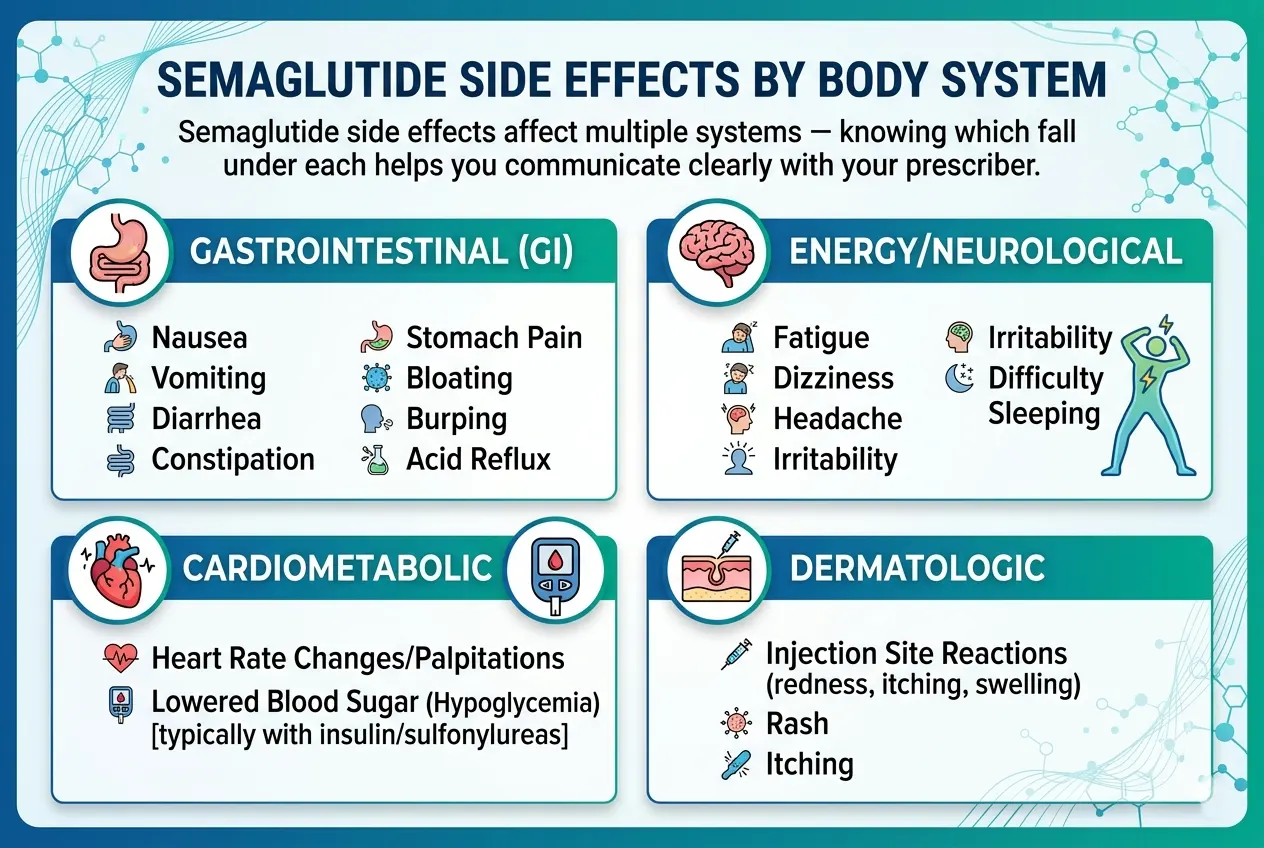
Gastrointestinal (Most Common)
Affects 15–44% of patients depending on dose and indication. Source: GoodRx pharmacist-reviewed semaglutide guide.
| Symptom | Typical Onset | Management |
|---|---|---|
| Nausea | 24–72 hrs after each injection | Small meals, low-fat, ginger, hydration |
| Vomiting | First weeks, dose increases | Smaller portions, slow eating, avoid lying down |
| Diarrhoea | First 2–4 weeks | Hydration, electrolytes, bland diet |
| Constipation | Weeks 4–12 onward | 25–35 g fibre, 2.5–3 L water, daily movement, magnesium citrate |
| Reflux / “Ozempic burps” | Weeks 4–8 | Smaller meals, upright posture, avoid high-fat foods |
| Bloating | Throughout | Avoid carbonated drinks, smaller portions |
| Abdominal pain | First 4 weeks | Usually mild; severe pain requires medical attention |
Neurological and Energy
- Headache — often related to dehydration or low calorie intake
- Fatigue — common in weeks 1–8, often from reduced eating rather than drug toxicity
- Dizziness — usually mild; worsens with dehydration or rapid blood sugar drops
- “Brain fog” — reported by some patients during dose escalations
Management: Adequate hydration, sufficient calorie intake (at least 1,200–1,500 daily for women, 1,500–1,800 for men), and ensuring you reach daily protein targets. Persistent or severe symptoms warrant a prescriber discussion.
Muscle Loss (Important — Often Overlooked)
Rapid weight loss on semaglutide includes some lean muscle. Studies estimate 30–40% of weight lost on GLP-1 medications can be muscle mass if no countermeasures are taken. This is clinically significant because muscle drives your basal metabolic rate.
How to prevent:
- Hit your daily protein target without compromise — 25–35 g per meal
- Begin resistance training within the first 2 weeks of starting semaglutide
- Minimum 2 sessions per week of bodyweight or weighted resistance exercise
- Walking alone does not preserve muscle — strength training is required
Hair Shedding and “Ozempic Face”
Hair shedding affects roughly 3% of Wegovy patients in trials — almost always temporary and triggered by rapid weight loss rather than the drug itself. “Ozempic face” describes facial volume loss from fat reduction — a cosmetic consequence of weight loss, not a drug toxicity.
Management: Adequate protein, biotin and iron levels checked, gentle hair care during shedding periods. Hair regrowth typically begins 3–6 months after weight stabilises.
Injection Site Reactions
- Mild redness, itching, or tenderness at the injection site
- Usually resolves within 24–48 hours
- Rotating sites (abdomen, thigh, upper arm) and allowing the pen to reach room temperature before injecting reduces reactions
Serious Side Effects — When to Call Your Doctor Immediately
These are uncommon but require immediate medical attention. Source: Drugwatch (pharmacist-reviewed).
| Condition | Warning Signs | Action |
|---|---|---|
| Acute pancreatitis | Severe, persistent abdominal pain radiating to the back, with or without vomiting | Emergency care immediately, discontinue medication |
| Gallbladder disease | Upper right abdominal pain, fever, yellowing of skin or eyes | Urgent medical evaluation |
| Severe allergic reaction | Swelling of face, lips, throat, difficulty breathing, severe rash | Emergency care immediately |
| Thyroid C-cell tumour signs | Lump or swelling in neck, hoarseness, difficulty swallowing | See your doctor |
| Severe hypoglycaemia (if on insulin/sulfonylureas) | Shaking, confusion, sweating, loss of consciousness | 15 g fast-acting carb, then medical evaluation |
| Acute kidney injury | Reduced urination, severe fatigue, swelling in legs | Medical evaluation; usually from dehydration |
| Vision changes | Sudden vision loss in one eye | Emergency care — possible NAION reported in JAMA Ophthalmology, 2024 |
Pharmacist’s Perspective — Faryal Faisal, PharmD
The serious side effects look frightening on paper but are genuinely uncommon — most patients complete a full year of semaglutide therapy without experiencing any of them. The reason this section matters is recognition speed. If pancreatitis or a serious allergic reaction does occur, every hour matters. Memorising the warning signs takes 60 seconds and could save a life.
What Makes Side Effects Worse?
Many side effects are not the drug’s fault alone — they are amplified by avoidable triggers.
- High-fat fried foods — biggest nausea trigger
- Alcohol — worsens nausea, dehydration, and reflux; tolerance is significantly reduced on semaglutide
- Skipping meals — causes fatigue, dizziness, and worsens cravings later
- Large portions — triggers nausea within 30–60 minutes
- Lying down after eating — worsens reflux significantly
- Inadequate hydration — worsens nausea, constipation, fatigue, and headache
- Rapid dose escalation — discuss with your prescriber if symptoms are severe
When Side Effects Mean You Should Stop and Call Your Doctor
Most side effects are tolerable and resolve. These warrant a phone call to your prescriber:
- Vomiting more than 24 hours preventing fluid intake
- Severe abdominal pain that does not resolve in a few hours
- Diarrhoea lasting more than 3 days
- Constipation lasting more than 7 days despite fibre and fluids
- Persistent dizziness or near-fainting episodes
- Inability to eat or drink for more than 24 hours
- Signs of dehydration (dark urine, dry mouth, dizziness on standing)
- Any of the serious side effects listed above
Frequently Asked Questions
When do semaglutide side effects peak?
Side effects typically peak in the first 24–72 hours after each injection and again briefly after every dose increase. The overall worst phase for most patients is weeks 5–8 — coinciding with the first dose escalation to 0.5 mg. Most patients report significant improvement by week 12.
How long do semaglutide side effects last?
Most gastrointestinal side effects significantly improve within 4–8 weeks at any given dose. Each new dose escalation typically produces a 3–7 day return of symptoms that then settles. By month 3–4, most patients tolerate semaglutide well, with only occasional flares related to specific meals or stress.
What is the worst side effect of semaglutide?
For most patients, nausea is the most disruptive — but it almost always improves. The most clinically serious rare side effects are acute pancreatitis, gallbladder disease, and severe allergic reactions. These are uncommon but require immediate medical attention. Long-term muscle loss is significant if protein intake and resistance training are neglected.
Does the body get used to semaglutide?
Yes — this is exactly why the dose escalation schedule exists. Each 4-week step allows your gastrointestinal system, brain appetite centres, and metabolism to adapt before the next increase. Patients who push through the first 8 weeks almost always find the medication progressively easier to tolerate.
Can I stop semaglutide if side effects are bad?
You can — but you do not have to. Most side effects are time-limited. Before stopping, contact your prescriber. They can delay a dose escalation, suggest specific management strategies, or temporarily reduce your dose. Stopping abruptly typically leads to weight regain. If you do choose to stop, weight regain begins within weeks.
Do Ozempic and Wegovy have different side effects?
The side effects are the same — both contain semaglutide. The intensity may be slightly higher with Wegovy because it reaches a higher maintenance dose (2.4 mg vs Ozempic’s 1–2 mg). The dose escalation pattern is similar but Wegovy has more steps.
Tirzepatide-based medications (Mounjaro and Zepbound) are a different molecule with a distinct dose escalation schedule and side effect pattern — for that timeline see our pharmacist’s Mounjaro side effects week by week guide.
Should I take anti-nausea medication on semaglutide?
Most patients do not need prescription anti-nausea medication. Lifestyle strategies — smaller meals, ginger, hydration, avoiding fatty foods, staying upright after eating — are usually sufficient. If nausea is severe and persistent, discuss with your prescriber. Ondansetron is sometimes prescribed short-term during dose escalation.
Are semaglutide side effects worse on the higher Wegovy doses?
Some patients experience more intensity at the 2.4 mg Wegovy dose, but many tolerate it just as well as lower doses because the body has fully adapted by that point. Each dose increase brings a temporary flare; the body then adapts within 1–2 weeks. The dose escalation schedule is specifically designed to make the maximum dose tolerable.
Key Takeaways
- Side effects are predictable, dose-dependent, and time-limited for most patients
- Nausea typically peaks within 4–8 weeks and improves with body adaptation
- Each dose escalation produces a temporary, milder return of symptoms
- Weeks 2–6 are when most patients quit — this is the wrong time to stop
- Protein, hydration, and resistance training prevent the most common long-term issues (muscle loss, fatigue, constipation)
- Serious side effects are uncommon but recognisable — knowing the warning signs matters
- If symptoms are unmanageable, ask your prescriber to delay (not skip) a dose escalation
References
- Hawkins-Jarrett ZC, PharmD. 19 Ozempic and Wegovy side effects you should know about. GoodRx. 2026. https://www.goodrx.com/ozempic/semaglutide-side-effects
- Fella Health. How long do semaglutide side effects last? Timeline and management. 2026. https://www.fellahealth.com/guide/how-long-do-semaglutide-side-effects-last
- Drugwatch (Fill KS, PharmD reviewed). Ozempic side effects, common, serious risks & FDA warnings. 2026. https://www.drugwatch.com/drugs/ozempic/side-effects/
- Wilding JPH, et al. Once-weekly semaglutide in adults with overweight or obesity (STEP-1). N Engl J Med. 2021;384:989–1002. https://www.nejm.org/doi/full/10.1056/NEJMoa2032183
- Ozempic (semaglutide) Prescribing Information. Novo Nordisk. 2025. https://www.accessdata.fda.gov/drugsatfda_docs/label/2025/209637s035lbl.pdf
- Wegovy (semaglutide 2.4 mg) Prescribing Information. Novo Nordisk. https://www.novo-pi.com/wegovy.pdf
- Marx W, et al. Ginger for nausea and vomiting — systematic review. PMC. 2015. https://www.ncbi.nlm.nih.gov/pmc/articles/PMC4818021/
- GLP-1 receptor agonists — mechanism overview. StatPearls, NCBI Bookshelf. https://www.ncbi.nlm.nih.gov/books/NBK551568/