

Search “how many calories in 3 eggs” and you’ll get a dozen different answers — 162, 189, 215, 220, 270, 300, 400. All of them are correct. All of them are also incomplete.
The real calorie count for 3 eggs depends on three variables most nutrition apps ignore: egg size, cooking method, and added fats. A boiled 3-small-egg breakfast is 162 calories. A cheese omelette with 3 jumbo eggs in butter can hit 480+. That’s a 300-calorie difference for what people call “3 eggs.”
This pharmacist-written guide gives you the exact number for your 3 eggs — by size, by cooking method, with complete nutrition, plus a free Egg Calorie Calculator if you need to adjust for different quantities.
What you’ll find in this guide:
- Exact calories for 3 eggs by size (small, medium, large, extra-large, jumbo)
- Complete cooking method chart (boiled, poached, scrambled, fried, omelette)
- Full nutrition breakdown — protein, fat, vitamins, minerals
- Why the 2026 evidence has finally debunked the cholesterol myth
- How eggs fit into weight loss, keto, intermittent fasting, and GLP-1 medication plans
The Quick Answer (Then We’ll Explain Why It’s Not That Simple)
For 3 large eggs, boiled or poached with no added fats
— the most common reference point — you’re looking at approximately
215-220 calories, 19g of protein, and 15g of fat.
But that number changes dramatically based on size and preparation.
Here’s the complete chart:
Calories in 3 Eggs by Size
Egg size affects calorie count more than most people realise. The USDA grades eggs by weight, and the calorie difference between a small egg and a jumbo egg is substantial.
| Egg Size | Weight (each) | Calories per Egg | Calories in 3 Eggs |
|---|---|---|---|
| Small | 38 g | 54 kcal | ~162 kcal |
| Medium | 44 g | 63 kcal | ~189 kcal |
| Large | 50 g | 72 kcal | ~215–220 kcal |
| Extra-Large | 56 g | 80 kcal | ~240 kcal |
| Jumbo | 63 g | 90 kcal | ~270 kcal |
Most nutrition labels and recipes assume “large” eggs (about 50g each). When you read “3 eggs = 220 calories” online, that figure refers to large eggs unless stated otherwise. Source: USDA Food Data Central.
Calories in 3 Eggs by Cooking Method
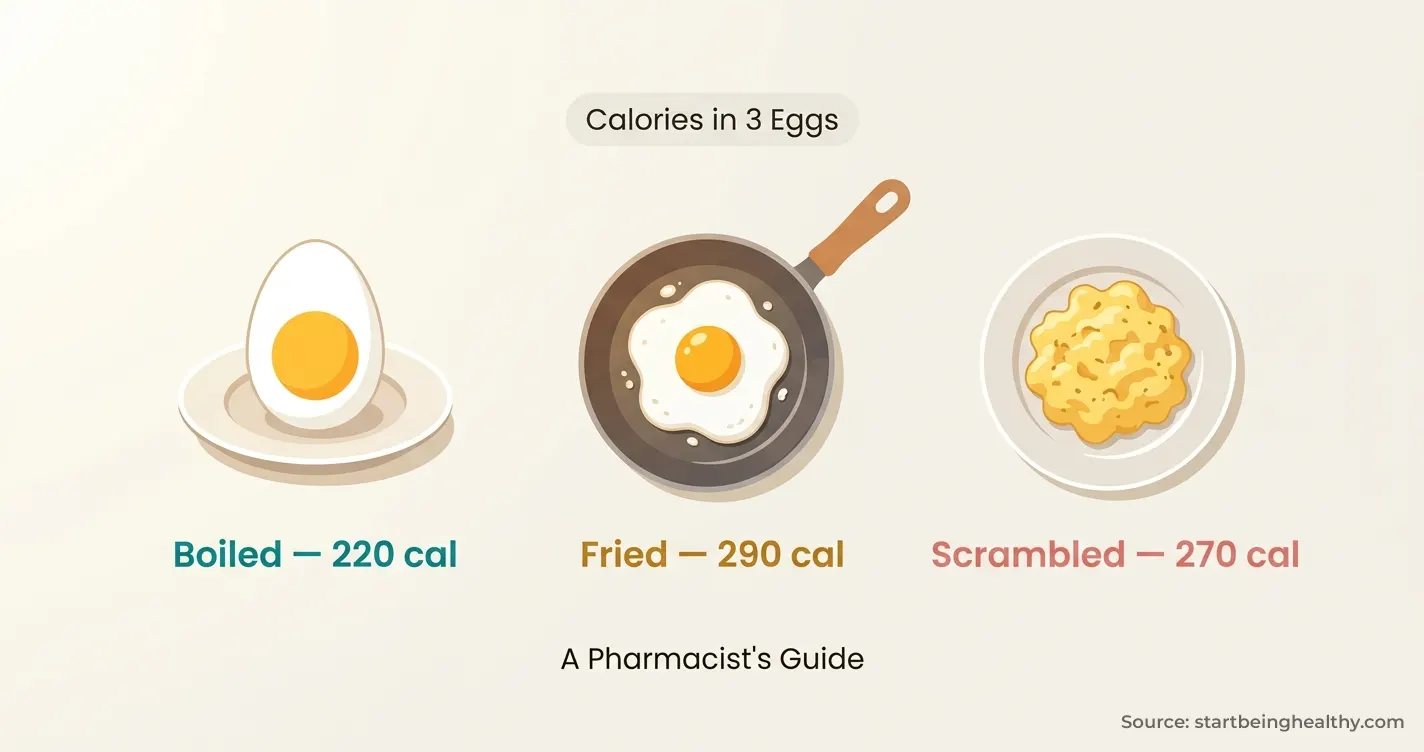
This is where most people get tripped up. Boiled and poached eggs keep their natural calorie count. Fried, scrambled, and omelette preparations add 50–200+ calories depending on fat and dairy.
| Cooking Method (3 Large Eggs) | Calories | Protein | Fat |
|---|---|---|---|
| Boiled (hard or soft) — no added fat | 215–220 kcal | 19 g | 15 g |
| Poached — no added fat | 215–220 kcal | 19 g | 15 g |
| Scrambled — dry, no butter or milk | 225–235 kcal | 19 g | 16 g |
| Scrambled — with 1 tsp butter | 265–280 kcal | 19 g | 20 g |
| Scrambled — with milk and butter | 290–310 kcal | 21 g | 22 g |
| Fried — 1 tsp oil or butter | 270–290 kcal | 19 g | 21 g |
| Fried — 1 tbsp oil or butter | 320–345 kcal | 19 g | 26 g |
| Omelette — with cheese and butter | 360–400 kcal | 25 g | 30 g |
| 3 egg whites only — boiled or scrambled dry | ~51 kcal | 11 g | 0 g |
Bottom line: If you are tracking calories carefully, boiled or poached eggs are your most reliable option. A “3-egg breakfast” can range from 215 to 400+ calories depending entirely on what you cook them in.
Pharmacist’s Perspective — Faryal Faisal, PharmD
The biggest mistake I see in patients tracking calories is underestimating cooking fats. A “scrambled eggs and toast” breakfast often clocks in at 500–600 calories when butter, milk, and bread are factored in — not the 220 they recorded for “3 eggs.” If you are on a calorie-controlled plan (especially while on GLP-1 medications like Ozempic where calorie tracking matters), boil or poach.
Complete Nutrition Facts for 3 Large Eggs
Eggs are one of the few foods classified as “nutritionally complete.” Three large eggs provide significant amounts of nearly every nutrient your body needs, with the notable exceptions of vitamin C and fibre.
| Nutrient | Amount (3 large eggs) | % Daily Value |
|---|---|---|
| Calories | 220 kcal | 11% |
| Protein | 18.9 g | 38% |
| Total Fat | 14.9 g | 19% |
| Saturated Fat | 4.6 g | 23% |
| Cholesterol | 560–630 mg | ~210% |
| Sodium | 210 mg | 9% |
| Carbohydrates | 1.2 g | <1% |
| Choline | 441 mg | 80% |
| Vitamin A | 210 mcg | 23% |
| Vitamin B12 | 1.3 mcg | 54% |
| Vitamin D | 6 mcg | 30% |
| Riboflavin (B2) | 0.7 mg | 54% |
| Selenium | 46 mcg | 84% |
| Iron | 2.7 mg | 15% |
| Calcium | 80 mg | 6% |
Sources: USDA FoodData Central; Egg nutrition review, PMC.
Are 3 Eggs a Day Healthy?
For most healthy adults, eating 3 eggs daily is well within safe limits. A 2020 BMJ meta-analysis of 1.7 million people found no significant association between moderate egg consumption (up to 1 egg per day) and cardiovascular disease risk in the general population. More recent reviews extend this safety profile to 2–3 eggs daily for healthy adults.
Who should be more cautious:
- People with type 2 diabetes — some studies suggest higher egg intake may modestly increase cardiovascular risk in diabetics. Discuss with your doctor
- Familial hypercholesterolaemia — genetic cholesterol disorders require individualised guidance
- Established heart disease — your cardiologist may recommend egg restriction
- Egg allergy — even small amounts can trigger reactions
The Cholesterol Myth — What the 2026 Evidence Shows
For decades, eggs were vilified for their cholesterol content. The science has shifted significantly. Current understanding:
- Dietary cholesterol has minimal effect on blood cholesterol for most people. About 75% of people are “hypo-responders” — their blood cholesterol barely changes with dietary cholesterol intake
- Saturated and trans fats matter far more — these are the dietary drivers of LDL (“bad”) cholesterol
- Eggs can raise HDL (“good”) cholesterol and shift LDL particles to a larger, less harmful subtype
- The 2020 Dietary Guidelines removed the previous 300 mg/day cholesterol cap, acknowledging that the evidence no longer supports it
Source: Harvard T.H. Chan School of Public Health; American Heart Association.
Eggs for Weight Loss: Why They Work
Eggs consistently rank among the most satiating foods studied. The reasons:
- Very high protein density — 19 g of protein in 220 calories is one of the best protein-to-calorie ratios available
- Low carbohydrate content — minimal impact on blood sugar, helping reduce mid-morning hunger
- High satiety index — research shows an egg breakfast leads to lower calorie intake at the next meal compared to a calorie-matched bagel breakfast
- Choline content supports liver function — relevant for healthy fat metabolism
If you are using eggs as part of a structured weight-loss plan, calculate your daily calorie target with our Calorie Calculator and pair eggs with our 21-Day Anti-Inflammatory Diet Plan.
Eggs and Weight Loss Medications: What You Need to Know
If you’re on a GLP-1 medication like Ozempic, Wegovy, Mounjaro, or Zepbound, eggs become one of the most important foods in your diet. Here’s why:
Muscle Preservation During Rapid Weight Loss
GLP-1 medications reduce appetite so effectively that many patients struggle to hit their daily protein target. This causes muscle loss alongside fat loss — a well-documented concern that can contribute to plateaus and metabolic slowdown.
Three eggs deliver 19g of complete protein in just 220 calories — one of the highest protein-to-calorie ratios of any food. That’s why they’re a foundational protein source in most GLP-1 meal plans.
Managing GI Side Effects
During dose escalation on medications like Mounjaro or semaglutide, many patients experience nausea. Boiled eggs are one of the best-tolerated protein sources during this period — no strong smell, no added fats, easy on the stomach.
For patients starting these medications, see our foods to avoid on GLP-1 medications guide alongside this egg nutrition breakdown.
Pharmacist’s Perspective — Faryal Faisal, PharmD
In my clinical experience, patients who preserve muscle while on GLP-1 medications maintain their weight loss results far better than those who lose weight rapidly without prioritising protein. Three eggs at breakfast — boiled or poached during the nausea-prone escalation phase — is one of the simplest evidence-based interventions available.
3 Eggs for Special Diets
Intermittent Fasting
Three boiled eggs make an excellent first meal to break a fast — high protein, low carb, and minimal insulin spike. Pair with non-starchy vegetables for a balanced break-fast meal. See our 16:8 intermittent fasting meal plan.
Keto and Low-Carb Diets
With only ~1 g of carbs total, 3 eggs are essentially a keto-perfect food. Fry them in butter or olive oil for added fats to hit keto macro targets.
High-Protein Diets
Three eggs provide 19 g of complete protein — about a third of the recommended daily target for an average adult. Particularly valuable for those on GLP-1 medications, who need to prioritise protein to preserve muscle mass during weight loss.
Mediterranean Diet
Eggs fit well within Mediterranean eating patterns when paired with vegetables, olive oil, and whole grains. Two to four eggs per week is the traditional pattern, though daily eggs are also evidence-supported.
Pharmacist’s Tips for Cooking Eggs the Healthier Way
Pharmacist’s Perspective — Faryal Faisal, PharmD
If your goal is weight loss or stable blood sugar, the order of egg-cooking methods from healthiest to least healthy is roughly: boiled or poached → scrambled in a nonstick pan (no butter) → soft-scrambled with a little milk → fried in olive oil → fried in butter → omelette with cheese. The macronutrient profile of the egg itself does not change — what changes is the cooking fat. A teaspoon of butter adds 36 calories. A tablespoon adds 100. These small changes accumulate quickly across the week.
Frequently Asked Questions
How many calories are in 3 boiled eggs?
Three large boiled eggs contain approximately 215–220 calories. Boiling adds no fat, so the calorie count matches the natural calorie content of the eggs themselves. Three medium boiled eggs are about 189 calories; three small boiled eggs are about 162 calories.
How many calories are in 3 fried eggs?
Three large fried eggs cooked with 1 teaspoon of oil contain about 270–290 calories. With 1 tablespoon of butter, the count rises to 320–345 calories. The exact total depends on how much fat is absorbed during cooking.
How many calories are in 3 scrambled eggs?
Three scrambled large eggs cooked dry contain about 225–235 calories. With 1 teaspoon of butter, expect 265–280 calories. With milk and butter combined, scrambled eggs typically reach 290–310 calories.
How much protein is in 3 eggs?
Three large eggs provide approximately 18–19 grams of high-quality complete protein, containing all nine essential amino acids. Protein content does not change with cooking method.
Is it healthy to eat 3 eggs every day?
For most healthy adults, yes. Current evidence does not support previous concerns about moderate daily egg intake and heart disease for the general population. People with type 2 diabetes, established heart disease, or genetic cholesterol disorders should consult their doctor first.
Do 3 eggs help with weight loss?
Yes. Three eggs provide 19 g of protein in 220 calories — one of the best protein-to-calorie ratios available. Eggs are highly satiating, meaning they help you feel full longer and eat less at subsequent meals. A boiled-egg breakfast is one of the most evidence-supported weight loss meals.
Are 3 eggs better than a protein shake?
Three eggs and a typical 25g whey protein shake provide similar amounts of protein. Eggs offer additional nutrients — choline, vitamin D, B12, selenium — that most protein shakes lack. Whey protein is faster absorbed, which can matter for post-workout windows. For everyday nutrition, whole eggs are nutritionally superior.
How many calories in 3 medium eggs?
Three medium eggs (44 g each) contain about 189 calories. Cooking method changes this — boiled is 189 calories, fried with oil is roughly 240–260 calories.
How many calories in 3 jumbo eggs?
Three jumbo eggs (63 g each) contain about 270 calories raw or boiled. Fried, the total can reach 320–360 calories depending on cooking fat.
Are eggs OK for cholesterol patients?
Most healthy people with normal cholesterol can safely eat 1–3 eggs daily. People with elevated LDL cholesterol, diabetes, or established cardiovascular disease should discuss specific egg intake with their doctor. For those needing to limit dietary cholesterol, egg whites alone (51 calories, 11 g protein per 3 whites) are an excellent alternative.
Calculate Calories for Any Number of Eggs
Need to calculate calories for 2 eggs, 4 eggs, 6 eggs, or any other quantity? Use our free, instant Egg Calorie Calculator — it accounts for egg size and gives complete nutrition breakdown in seconds.
You can also calculate your full daily calorie needs with our Calorie Calculator to see how many eggs fit your goals.
Key Takeaways
- 3 large eggs contain about 215–220 calories with 19 g of protein and 15 g of fat
- Egg size matters — small (162 kcal) to jumbo (270 kcal) is a wide range
- Cooking method changes calorie count significantly — fried and scrambled add 50–200+ calories
- Boiled and poached are the most reliable for calorie tracking
- Up to 3 eggs daily is safe for most healthy adults; people with diabetes or heart disease should consult a doctor
- The cholesterol myth is largely debunked — saturated and trans fats matter more
- Eggs are one of the most satiating foods and excellent for weight loss
References
- USDA FoodData Central. Egg, whole, raw, fresh. https://fdc.nal.usda.gov/
- Drouin-Chartier JP, et al. Egg consumption and risk of cardiovascular disease: three large prospective US cohort studies, systematic review, and updated meta-analysis. BMJ. 2020;368:m513. https://www.bmj.com/content/368/bmj.m513
- Réhault-Godbert S, et al. The golden egg: nutritional value, bioactivities, and emerging benefits for human health. PMC. 2019. https://www.ncbi.nlm.nih.gov/pmc/articles/PMC6315720/
- Harvard T.H. Chan School of Public Health. Eggs and cholesterol. https://www.harvard.edu/in-focus/eggs-cholesterol/
- American Heart Association. Are eggs good for you or not? https://www.heart.org/